What you'll be able to do本章學習成果
This chapter specializes the ideal-gas mixture model to moist air — the mixture of dry air and water vapor that air-conditioning engineering is built on. (For mixture composition and the Dalton model in general, see Ideal Gas, Mixtures & Compressibility — Dalton model.)本章將理想氣體混合模型專門應用於濕空氣 — 即乾空氣與水蒸氣的混合物,為空調工程的基礎。(關於混合物組成與一般道耳頓模型,請參閱理想氣體、混合與壓縮因子 — 道耳頓模型。)
- Work fluently with psychrometric terminology: humidity ratio, relative humidity, mixture enthalpy, dew point.熟練運用濕空氣術語:濕度比、相對濕度、混合物焦、露點。
- Relate moist-air partial pressures through the Dalton model (dry air + water vapor).透過道耳頓模型(乾空氣+水蒸氣)聯結濕空氣的各分壓。
- Read the psychrometric chart and retrieve any property from two known ones.讀取濕空氣線圖,由兩個已知性質查出任一其他性質。
- Apply mass & energy balances to analyze heating, dehumidification, humidification, mixing, and cooling towers.運用質量與能量平衡分析加熱、除濕、加濕、混合與冷却塔。
Key equations重要公式
Moist air濕空氣
Moist air is an ideal-gas mixture. In the Dalton model each component behaves as if it alone occupies the volume at temperature T, so pressures add: $p = p_a + p_v$, and each partial pressure is the mole fraction times the total: $p_i = y_i p$. Review the Dalton model →濕空氣是理想氣體混合物。在道耳頓模型中,每一成分都表現得如同它單獨在溫度 T 下佔有整個體積,因此壓力可相加:$p = p_a + p_v$,且每一分壓等於莫爾分率乘以總壓:$p_i = y_i p$。複習道耳頓模型 →
Moist air is a mixture of dry air (treated as one pure component) and water vapor. The study of such systems is called psychrometrics. Writing $m_a$ for the mass of dry air and $m_v$ for the mass of water vapor in a given sample, the crucial fact is that the vapor is tiny compared to the dry air: $m_v \ll m_a$.濕空氣是乾空氣(視為單一純物質)與水蒸氣的混合物。研究這類系統的學問稱為濕空氣學(濕度學)。以 $m_a$ 表示樣本中乾空氣的質量、$m_v$ 表示水蒸氣的質量,關鍵在於水蒸氣的量與乾空氣相比極小:$m_v \ll m_a$。
Applying the Dalton model with gas 1 = dry air and gas 2 = water vapor, the mixture pressure splits into partial pressures:以道耳頓模型套用(氣體 1 =乾空氣,氣體 2 =水蒸氣),混合物壓力可拆解為各分壓:
At a typical state the water vapor is superheated at partial pressure $p_v$ and temperature T. As $p_v$ rises toward the saturation pressure $p_g(T)$, the air approaches saturation — it holds as much vapor as it can at that temperature.在典型狀態下,水蒸氣是在分壓 $p_v$ 與溫度 T 下的過熱蒸氣。當 $p_v$ 升高至接近飽和壓力 $p_g(T)$ 時,空氣越來越接近飽和 — 在該溫度下容納了所能容納的最大蒸氣量。
Humidity ratio, relative humidity & mixture enthalpy濕度比、相對濕度與混合物焦
Relative humidity相對濕度
Relative humidity $\phi$ compares the actual vapor pressure to the saturation pressure at the same temperature — how "full" the air is, from 0 to 100%:相對濕度 $\phi$ 是實際蒸氣壓與同溫下飽和壓力的比值 — 表示空氣「陰」的程度,由 0 至 100%:
where, both evaluated at the mixture temperature $T$:其中,兩者皆於混合物溫度 $T$ 下取值:
- $p_v$ — the actual partial pressure of the water vapor present in the moist air.$p_v$ — 濕空氣中水蒸氣的實際分壓。
- $p_g = p_g(T)$ — the saturation pressure of water at that temperature, i.e. the largest vapor pressure the air can sustain before condensation begins. It is read straight from the steam tables as $p_{\text{sat}}(T)$.$p_g = p_g(T)$ — 該溫度下水的飽和壓力,即空氣在開始凝結前所能維持的最大蒸氣壓。可直接由蒸汽表以 $p_{\text{sat}}(T)$ 查得。
When $p_v = p_g$ the air is saturated and $\phi = 100\%$; when the air is bone dry, $p_v = 0$ and $\phi = 0$.當 $p_v = p_g$ 時空氣飽和,$\phi = 100\%$;當空氣極乾時,$p_v = 0$,$\phi = 0$。
Humidity ratio (specific humidity)濕度比(比濕度)
The humidity ratio $\omega$ is the mass of water vapor per unit mass of dry air. Using $p_a = p - p_v$ and the molecular-weight ratio $M_v/M_a = 18.02/28.97 = 0.622$:濕度比 $\omega$ 是每單位質量乾空氣中的水蒸氣質量。以 $p_a = p - p_v$ 與分子量比 $M_v/M_a = 18.02/28.97 = 0.622$ 代入:
Derivation推導 From the definition to $0.622\,p_v/(p-p_v)$由定義導出 $0.622\,p_v/(p-p_v)$ ›
Step 1 — Start from the definition. The humidity ratio is mass of water vapor per unit mass of dry air:步驟 1 — 由定義出發。濕度比是每單位質量乾空氣中的水蒸氣質量:
$$ \omega = \frac{m_v}{m_a} $$
Step 2 — Treat each component as an ideal gas (Dalton model). Both the dry air and the vapor occupy the same volume $V$ at the same temperature $T$; each obeys $pV = mRT$ with $R = R_u/M$. Solving each for mass:步驟 2 — 將各成分視為理想氣體(道耳頓模型)。乾空氣與水蒸氣佔有相同體積 $V$、處於相同溫度 $T$;各自滿足 $pV = mRT$,其中 $R = R_u/M$。分別解出質量:
$$ m_v = \frac{p_v V}{R_v T} = \frac{p_v V M_v}{R_u T}, \qquad m_a = \frac{p_a V}{R_a T} = \frac{p_a V M_a}{R_u T} $$
Step 3 — Take the ratio. The common factors $V$, $T$, and $R_u$ cancel, leaving only pressures and molecular weights:步驟 3 — 取比值。共同因子 $V$、$T$ 與 $R_u$ 相消,僅留下壓力與分子量:
$$ \omega = \frac{m_v}{m_a} = \frac{p_v M_v}{p_a M_a} = \frac{M_v}{M_a}\,\frac{p_v}{p_a} $$
Step 4 — Insert the molecular-weight ratio. Water is $M_v = 18.02$ and dry air $M_a = 28.97$ kg/kmol, so $M_v/M_a = 18.02/28.97 = 0.622$:步驟 4 — 代入分子量比。水為 $M_v = 18.02$、乾空氣 $M_a = 28.97$ kg/kmol,故 $M_v/M_a = 18.02/28.97 = 0.622$:
$$ \omega = 0.622\,\frac{p_v}{p_a} $$
Step 5 — Eliminate $p_a$ with Dalton's rule. Total pressure splits as $p = p_a + p_v$, so $p_a = p - p_v$. Substituting gives the working form:步驟 5 — 以道耳頓法則消去 $p_a$。總壓拆解為 $p = p_a + p_v$,故 $p_a = p - p_v$。代入即得實用式:
$$ \boxed{\;\omega = 0.622\,\dfrac{p_v}{p - p_v}\;} $$
Only the vapor partial pressure $p_v$ and the total pressure $p$ remain — both readable from the chart or measurable directly.最終僅剩蒸氣分壓 $p_v$ 與總壓 $p$ — 兩者皆可由線圖讀取或直接量測。
Because $m_v \ll m_a$, $\omega$ is typically much less than 1 (a few grams of water per kilogram of dry air).因為 $m_v \ll m_a$,$\omega$ 通常遠小於 1(每公斤乾空氣僅含幾公克水)。
Mixture enthalpy混合物焦
Enthalpy is found by adding contributions. Per unit mass of dry air, with the vapor enthalpy well approximated by the saturated-vapor value $h_v \approx h_g(T)$:焦值由各項貢獻相加而得。以每單位質量乾空氣計,並以飽和蒸氣值近似蒸氣焦 $h_v \approx h_g(T)$:
where:其中:
- $H$ — the total enthalpy of the moist-air sample (dry air + vapor).$H$ — 濕空氣樣本的總焓(乾空氣+水蒸氣)。
- $m_a$ — the mass of dry air; dividing by it puts everything on a "per kg of dry air" basis.$m_a$ — 乾空氣質量;以其相除即化為「每公斤乾空氣」基準。
- $h_a$ — specific enthalpy of the dry air (per kg dry air).$h_a$ — 乾空氣的比焓(每公斤乾空氣)。
- $h_v$ — specific enthalpy of the water vapor (per kg vapor).$h_v$ — 水蒸氣的比焓(每公斤水蒸氣)。
- $\omega = m_v/m_a$ — the humidity ratio, which converts the vapor term to the per-kg-dry-air basis.$\omega = m_v/m_a$ — 濕度比,將蒸氣項換算為每公斤乾空氣基準。
- $c_{pa} \approx 1.005\ \mathrm{kJ/kg\cdot K}$ — specific heat of dry air at constant pressure.$c_{pa} \approx 1.005\ \mathrm{kJ/kg\cdot K}$ — 定壓下乾空氣的比熱。
- $T$ — the dry-bulb temperature measured from the chosen reference (0 °C).$T$ — 由所選參考點(0 °C)量起的乾球溫度。
- $h_g = h_g(T)$ — specific enthalpy of saturated water vapor at temperature $T$, read from the steam tables.$h_g = h_g(T)$ — 溫度 $T$ 下飽和水蒸氣的比焓,由蒸汽表查得。
Derivation推導 From $H = m_a h_a + m_v h_v$ to $c_{pa}T + \omega h_g$由 $H = m_a h_a + m_v h_v$ 導出 $c_{pa}T + \omega h_g$ ›
Step 1 — Enthalpy is extensive, so contributions add. The total enthalpy of the mixture is the dry-air enthalpy plus the vapor enthalpy:步驟 1 — 焓為廣延性質,故各貢獻相加。混合物的總焓等於乾空氣焓加上水蒸氣焓:
$$ H = m_a h_a + m_v h_v $$
Step 2 — Divide through by $m_a$. Reporting per unit mass of dry air (which is conserved through every process) and using $\omega = m_v/m_a$:步驟 2 — 全式除以 $m_a$。以每單位質量乾空氣表示(其在每個過程中守恆),並代入 $\omega = m_v/m_a$:
$$ \frac{H}{m_a} = h_a + \frac{m_v}{m_a}\,h_v = h_a + \omega\,h_v $$
Step 3 — Model the dry air as an ideal gas. With constant specific heat and the reference $h_a = 0$ at $T = 0\,°\mathrm{C}$, its enthalpy depends on temperature alone:步驟 3 — 將乾空氣視為理想氣體。取定比熱,並令參考點 $T = 0\,°\mathrm{C}$ 時 $h_a = 0$,其焓僅與溫度有關:
$$ h_a \approx c_{pa}\,T $$
Step 4 — Approximate the vapor enthalpy. The vapor is superheated but at very low partial pressure, where enthalpy is nearly a function of temperature only. So it is well approximated by the saturated-vapor value at the same $T$:步驟 4 — 近似蒸氣焓。蒸氣雖為過熱,但分壓極低,此時焓幾乎僅為溫度的函數。故可用同溫下的飽和蒸氣值良好近似:
$$ h_v \approx h_g(T) $$
Step 5 — Combine. Substituting Steps 3 and 4 into the result of Step 2:步驟 5 — 合併。將步驟 3、4 代入步驟 2 的結果:
$$ \boxed{\;\frac{H}{m_a} = h_a + \omega\,h_v \;\approx\; c_{pa}T + \omega\,h_g(T)\;} $$
The first term is the sensible contribution of the dry air; the second carries the vapor's enthalpy, dominated by its latent content through $h_g$.第一項是乾空氣的顯熱貢獻;第二項承載水蒸氣的焓,並透過 $h_g$ 由其潛熱含量主導。
Try it — the moist-air state explorer動手試試 — 濕空氣狀態探索器
Two independent properties fix the state. Drag on the chart, or set dry-bulb temperature and relative humidity, and watch every other property update. Notice how the state point can never cross the saturation line (φ = 100%).兩個獨立性質即可固定狀態。在線圖上拖曳,或設定乾球溫度與相對濕度,觀察其他性質隨之更新。注意狀態點永遠不會跨越飽和線(φ = 100%)。
Dew point temperature露點溫度
Cool moist air at constant pressure and the vapor cools at constant $p_v$ (constant $\omega$). The temperature at which it first reaches saturation is the dew point, $T_{dp}$ — the temperature where $p_g(T_{dp}) = p_v$. Cool below it and water condenses (dew on grass, fog on a cold glass).在定壓下冷卻濕空氣,蒸氣在定 $p_v$(定 $\omega$)下降溫。首次達到飽和的溫度即為露點 $T_{dp}$ — 即滿足 $p_g(T_{dp}) = p_v$ 的溫度。冷卻至低於此溫度,水便凝結(草上的露珠、冷玻璃上的霧氣)。
The water condensed per unit mass of dry air as the air cools from state 1 to state 2 is the drop in humidity ratio:空氣由狀態 1 冷卻至狀態 2 時,每單位質量乾空氣所凝結的水量即濕度比的下降量:
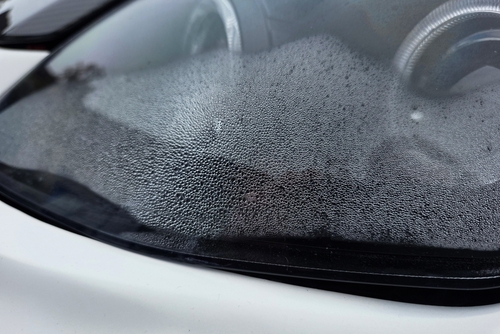
- Inside fog: which side of the glass is below the dew point — the interior air's or the exterior air's?內側起霧:玻璃哪一面低於露點 — 車內空氣的,還是車外空氣的?
- Heater or AC? To clear inside fog, should you switch on the windshield heater (warms the glass) or divert cold air from the air conditioning onto the windshield? Think about what each does to the relevant psychrometric property — does it raise the glass temperature or lower the interior dew point?加熱還是冷氣?要消除內側霧氣,應該開啟除霧加熱器(加熱玻璃),還是將冷氣的冷風導向擋風玻璃?想想兩者各自對相關濕空氣性質做了什麼 — 是提高玻璃溫度,還是降低車內露點?
- Modern cars automatically run the AC compressor when defrost is selected, even in winter. Why? (Hint: what does the AC evaporator do to $\omega$?)現代車輛選擇除霧模式時,即使是冬天也會自動啟動冷氣壓縮機。為什麼?(提示:冷氣蒸發器對 $\omega$ 做了什麼?)
- Outside frost: the air temperature is +3°C but frost still forms. Is that possible? What condition is required?外側結霜:氣溫為 +3°C 卻仍結霜,有可能嗎?需要什麼條件?
- The interior air's dew point is exceeded at the cold glass surface. Warm moist cabin air (breath, wet clothing) contacts the cold glass; where the glass is below $T_{dp}$ of the interior air, condensation forms on the inside face.車內空氣的露點在冷玻璃面被超過。溫暖潮濕的車內空氣(呼吸、濕衣物)接觸冷玻璃;凡玻璃低於車內空氣 $T_{dp}$ 之處,內面即產生凝結。
- Both work, by different mechanisms. The heater raises glass temperature above the interior dew point — condensation cannot form on a surface warmer than $T_{dp}$. The AC dehumidifies cabin air, lowering ω and thus $T_{dp}$ below the glass temperature — condensation stops because the dew point is now lower than the glass. The fastest fix is usually AC + fan together.兩者都有效,但機制不同。加熱器提高玻璃溫度至高於車內露點 — 表面溫度高於 $T_{dp}$ 即不會凝結。冷氣則為車內空氣除濕,降低 ω 並使 $T_{dp}$ 低於玻璃溫度 — 露點低於玻璃後凝結停止。最快的方法通常是冷氣加風扇並用。
- The AC evaporator cools air below its dew point, stripping moisture as condensate — it lowers ω. Reheating that dry air with the cabin heater delivers warm, low-humidity air that clears fog without re-saturating at the glass.冷氣蒸發器將空氣冷至低於露點,以凝結水形式去除水分 — 降低 ω。再以車內加熱器加熱該乾燥空氣,送出溫暖低濕的空氣,不會在玻璃面重新飽和,即可消霧。
- Yes — if the glass surface falls below 0 °C. On a clear night the glass radiates to a very cold sky (effective sky temperature can be −20 °C or lower), dropping the glass surface below freezing even when air T > 0 °C. If $T_{\text{glass}}$ < $T_{dp}$ of the outdoor air, frost deposits as ice.有可能 — 只要玻璃表面降至 0 °C 以下。晴朗夜晚玻璃向極冷的天空輻射(有效天空溫度可低至 −20 °C 或更低),即使氣溫 T > 0 °C,玻璃表面仍可降至冰點以下。若 $T_{\text{glass}}$ < 外界空氣的 $T_{dp}$,霜即以冰晶形式沉積。
The dew point is found by moving horizontally (constant $\omega$) left from a state until you hit the saturation curve. Try it in the explorer above — the dew-point readout is exactly that intersection temperature.露點的找法:由狀態點水平(定 $\omega$)向左移動,直到碰到飽和曲線。在上方探索器試試看 — 露點讀數正是該交點溫度。
Dry-bulb & wet-bulb temperatures乾球與濕球溫度
Two easily measured temperatures characterize moist air. The dry-bulb temperature $T_{db}$ is what an ordinary thermometer reads. The wet-bulb temperature $T_{wb}$ is read from a thermometer whose bulb is wrapped in a water-moistened wick with air flowing over it.兩個易於量測的溫度可描述濕空氣。乾球溫度 $T_{db}$ 是一般溫度計所讀的值。濕球溫度 $T_{wb}$ 則是將溫度計球部包上水濕紗布、並有空氣流過時所讀的值。
Evaporation from the wick cools it, so $T_{wb} \le T_{db}$ — and the gap between them grows as the air gets drier. The two readings on a sling psychrometer are enough to fix the state, which is why these temperatures anchor the psychrometric chart.紗布上的蒸發使其冷卻,故 $T_{wb} \le T_{db}$ — 且空氣越乾,兩者差距越大。產生於乾濕球濕度計的這兩個讀數足以固定狀態,這也是這兩個溫度能錨定濕空氣線圖的原因。
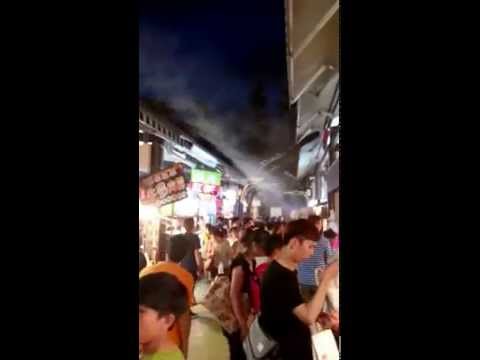
- When $\phi = 100\%$, what is $T_{wb}$ compared to $T_{db}$? Why does misting stop working when the air is already saturated?當 $\phi = 100\%$ 時,$T_{wb}$ 與 $T_{db}$ 相比如何?為何空氣已飽和時噴霧就失效?
- How much can the mist cool you? On a typical Taiwan summer night: $T_{db} = 34°\mathrm{C}$, $\phi = 70\%$. Use the state explorer to find $T_{wb}$. The mist can cool the local air toward $T_{wb}$ — how many degrees of relief does that give? Is it enough to feel comfortable?噴霧能為你降多少溫?典型的台灣夏夜:$T_{db} = 34°\mathrm{C}$、$\phi = 70\%$。用狀態探索器找出 $T_{wb}$。噴霧可將局部空氣冷卻至接近 $T_{wb}$ — 能帶來幾度的涼意?足以讓人感到舒適嗎?
- The mist works better when wind is blowing. Why? Think about what the wind does to $\phi$ near the nozzle.有風時噴霧效果更好,為什麼?想想風對噴嘴附近的 $\phi$ 做了什麼。
- At φ = 100%, $T_{wb}$ = $T_{db}$. The air is already saturated — mist has nowhere to evaporate, no latent heat is absorbed, and no cooling occurs.當 φ = 100% 時,$T_{wb}$ = $T_{db}$。空氣已飽和 — 噴霧無處蒸發,不吸潛熱,也就不會降溫。
- $T_{wb}$ ≈ 27.5 °C at T = 34 °C, φ = 70%. (Verify in the explorer.) The mist cooling limit is about 34 − 27.5 = 6.5 °C of relief, bringing perceived temperature close to 27–28 °C — noticeably more comfortable. In a crowded still-air night market the local φ rises as mist evaporates, so real relief is somewhat less.在 T = 34 °C、φ = 70% 下,$T_{wb}$ ≈ 27.5 °C。(請在探索器中驗證。)噴霧降溫極限約為 34 − 27.5 = 6.5 °C 的涼意,使體感溫度接近 27–28 °C — 明顯舒適許多。但在擁撠且空氣不流通的夜市,噴霧蒸發使局部 φ 上升,實際涼意略少。
- Wind replenishes drier ambient air near the nozzle. As mist evaporates it raises local φ toward 100%, slowing further evaporation. Wind sweeps away moisture-laden air and brings in drier air, sustaining the evaporation driving force.風為噴嘴附近補充較乾的環境空氣。噴霧蒸發使局部 φ 接近 100%,減緩進一步蒸發。風將含濕空氣吜走、帶入較乾空氣,維持蒸發的驅動力。
Reading the psychrometric chart讀取濕空氣線圖
The psychrometric chart packs every moist-air property into one diagram (drawn for $p = 1$ atm). Fix any two and read the rest:濕空氣線圖將所有濕空氣性質整合於一張圖(以 $p = 1$ atm 繪製)。固定任兩個性質,其餘即可讀出:
- Dry-bulb temperature $T_{db}$ — horizontal axis.乾球溫度 $T_{db}$ — 横軸。
- Humidity ratio $\omega$ — right vertical axis.濕度比 $\omega$ — 右側縱軸。
- Relative humidity $\phi$ — the family of curves; the bold one at the top-left is saturation, $\phi = 100\%$.相對濕度 $\phi$ — 一組曲線;左上方那條粗線即為飽和線 $\phi = 100\%$。
- Dew point — follow constant $\omega$ left to the saturation line.露點 — 沿定 $\omega$ 向左至飽和線。
- Mixture enthalpy $(h_a + \omega h_v)$ — the faint diagonal lines (nearly parallel to constant wet-bulb lines).混合物焦 $(h_a + \omega h_v)$ — 淡色斜線(幾乎與定濕球線平行)。
For $T_{db}=30°\mathrm{C}$ and $T_{wb}=25°\mathrm{C}$, the chart gives $\phi \approx 67\%$, $\omega \approx 0.0181$ kg/kg, and $(h_a+\omega h_v)\approx 76$ kJ/kg dry air. Set $T \approx 30$, $\phi \approx 67\%$ in the explorer to confirm.當 $T_{db}=30°\mathrm{C}$、$T_{wb}=25°\mathrm{C}$ 時,線圖給出 $\phi \approx 67\%$、$\omega \approx 0.0181$ kg/kg、$(h_a+\omega h_v)\approx 76$ kJ/kg 乾空氣。在探索器中設 $T \approx 30$、$\phi \approx 67\%$ 以驗證。
Analyzing air-conditioning processes分析空調過程
Every device below is analyzed the same way: a steady-state control volume with mass balances on dry air and water plus an energy balance. Dry air flow $\dot m_a$ is constant throughout, so results are reported per unit mass of dry air. The simulator lets you run all four core processes and watch the path trace across the chart.下列每個裝置均以同一方式分析:穩態控制體積,對乾空氣與水分別列質量平衡,再加上能量平衡。乾空氣質流 $\dot m_a$ 全程不變,故結果以每單位質量乾空氣表示。模擬器讓你執行四個核心過程,並觀察路徑在線圖上繪出。
Try it — the process simulator動手試試 — 過程模擬器
Pick a process, set the inlet conditions, and read off the engineering results — heat duty, condensate rate, exit state — as the process path draws itself on the chart.選一個過程,設定入口條件,隨著過程路徑在線圖上繪出,讀取工程結果 — 熱負荷、凝結水量、出口狀態。
Dehumidification除濕
To remove moisture, moist air flows across a cooling coil cold enough to condense water. Saturated air exits at state 2 ($T_2 < T_1$), and condensate drains as saturated liquid at $T_3 = T_2$. The mass balance gives the condensate, and the energy balance gives the cooling load:要去除水分,濕空氣流過冷到足以使水凝結的冷却盤管。飽和空氣於狀態 2 離開($T_2 < T_1$),凝結水則以 $T_3 = T_2$ 的飽和液體排出。質量平衡給出凝結水量,能量平衡給出冷却負荷:
Derivation推導 Condensate from two mass balances由兩個質量平衡導出凝結水量 ›
Symbols. Take the cooling coil as a steady-state control volume with one air inlet (1), one air outlet (2), and one liquid drain (w):符號定義。將冷却盤管視為穩態控制體積,具一個空氣入口 (1)、一個空氣出口 (2) 與一個液體排放口 (w):
- $\dot m_a$ — mass flow rate of dry air (kg/s). It is the same at inlet and outlet because dry air is neither added nor removed.乾空氣的質流率 (kg/s)。因乾空氣不增不減,入口與出口相同。
- $\dot m_{v1},\ \dot m_{v2}$ — mass flow rates of water vapor in the air at inlet and outlet (kg/s).入口與出口空氣中水蒸氣的質流率 (kg/s)。
- $\dot m_w$ — mass flow rate of liquid condensate draining off the coil (kg/s).自盤管排出的液態凝結水質流率 (kg/s)。
- $\omega_1,\ \omega_2$ — humidity ratios at inlet and outlet, $\omega = \dot m_v/\dot m_a$ (kg water / kg dry air).入口與出口的濕度比,$\omega = \dot m_v/\dot m_a$(kg 水 / kg 乾空氣)。
Step 1 — Dry-air mass balance. No dry air is created or destroyed, so the inlet and outlet dry-air flows are equal — this is what lets us call both $\dot m_a$:步驟 1 — 乾空氣質量平衡。乾空氣不生不滅,故入口與出口乾空氣流量相等 — 這正是兩者皆記為 $\dot m_a$ 的原因:
$$ \dot m_{a1} = \dot m_{a2} = \dot m_a $$
Step 2 — Water mass balance. Every bit of water entering as vapor must leave either as vapor in the exit air or as liquid condensate:步驟 2 — 水的質量平衡。以蒸氣進入的水,必以出口空氣中的蒸氣或以液態凝結水離開:
$$ \dot m_{v1} = \dot m_{v2} + \dot m_w \quad\Longrightarrow\quad \dot m_w = \dot m_{v1} - \dot m_{v2} $$
Step 3 — Rewrite vapor flows via the humidity ratio. By definition $\omega = \dot m_v/\dot m_a$, so $\dot m_v = \omega\,\dot m_a$ at each port:步驟 3 — 以濕度比改寫蒸氣流量。依定義 $\omega = \dot m_v/\dot m_a$,故各埠 $\dot m_v = \omega\,\dot m_a$:
$$ \dot m_{v1} = \omega_1 \dot m_a, \qquad \dot m_{v2} = \omega_2 \dot m_a $$
Step 4 — Substitute and divide by $\dot m_a$. Putting these into the water balance and factoring out the (common) dry-air flow:步驟 4 — 代入並除以 $\dot m_a$。代入水平衡並提出(共同的)乾空氣流量:
$$ \dot m_w = \omega_1 \dot m_a - \omega_2 \dot m_a = (\omega_1 - \omega_2)\,\dot m_a $$
$$ \boxed{\;\frac{\dot m_w}{\dot m_a} = \omega_1 - \omega_2\;} $$
The condensate per unit of dry air is simply the drop in humidity ratio across the coil. Since the coil dries the air, $\omega_2 < \omega_1$ and $\dot m_w > 0$.每單位乾空氣的凝結水量,就是空氣通過盤管時濕度比的降幅。因盤管使空氣變乾,$\omega_2 < \omega_1$,故 $\dot m_w > 0$。
Heat flows from the air to the coil, so $\dot Q_{cv}/\dot m_a$ is negative. On the chart the path runs left at constant $\omega$ to the dew point, then down the saturation curve.熱從空氣流向盤管,故 $\dot Q_{cv}/\dot m_a$ 為負。在線圖上,路徑先沿定 $\omega$ 向左至露點,再沿飽和曲線向下。
Humidification加濕
A humidifier adds water vapor by injecting steam or liquid. The water mass balance sets the exit humidity ratio directly from the injected flow $\dot m_3$:加濕器藉注入蒸氣或液體來增加水蒸氣。水的質量平衡可由注入流量 $\dot m_3$ 直接決定出口濕度比:
The energy balance (adiabatic, no work) then fixes the exit temperature:能量平衡(絕熱、無功)接著決定出口溫度:
Inject high-temperature steam and the air warms slightly; inject liquid and the air may cool as the water evaporates into it.注入高溫蒸氣,空氣略微變暖;注入液體,空氣則可能因水蒸發入其中而變冷。
Adiabatic mixing of two streams兩股氣流的絕熱混合
Mixing two moist-air streams adiabatically, the dry-air and water mass balances combine with the energy balance to give the exit state. The mass-flow ratio is set by the humidity ratios:絕熱混合兩股濕空氣流時,乾空氣與水的質量平衡搭配能量平衡即可決定出口狀態。質流比由濕度比決定:
On the psychrometric chart, the mixed state 3 lies on the straight line connecting states 1 and 2 — and divides it in proportion to the mass flow rates. The simulator draws that line; drag the flow sliders to slide state 3 along it.在濕空氣線圖上,混合狀態 3 位於連接狀態 1 與 2 的直線上 — 並依質流比例分割該線段。模擬器會畫出該線;拖曳質流滑桿可使狀態 3 沿線滑動。
Worked example範例 Adiabatic mixing絕熱混合 ›
Stream 1: $T=24°\mathrm{C}$, $\omega_1=0.0094$, $\dot m_{a1}=497$ kg/min. Stream 2: $T=5°\mathrm{C}$, $\omega_2=0.002$, $\dot m_{a2}=180$ kg/min.氣流 1:$T=24°\mathrm{C}$、$\omega_1=0.0094$、$\dot m_{a1}=497$ kg/min。氣流 2:$T=5°\mathrm{C}$、$\omega_2=0.002$、$\dot m_{a2}=180$ kg/min。
From the mass-flow ratio: $\dfrac{497}{180} = \dfrac{0.002-\omega_3}{\omega_3-0.0094}$, giving $\omega_3 = 0.0074$ kg/kg.由質流比:$\dfrac{497}{180} = \dfrac{0.002-\omega_3}{\omega_3-0.0094}$,得 $\omega_3 = 0.0074$ kg/kg。
Reading the chart (or the energy balance) gives $T_3 \approx 19°\mathrm{C}$. Set these inputs in the simulator's "Adiabatic mixing" mode to reproduce it.讀取線圖(或能量平衡)得 $T_3 \approx 19°\mathrm{C}$。在模擬器的「絕熱混合」模式輸入這些值即可重現。
Dehumidification cooling load除濕冷却負荷
Worked example範例 Cooling-coil energy balance冷却盤管能量平衡 ›
Moist air enters a cooling coil at $T_1 = 30°\mathrm{C}$, $\omega_1 = 0.0180$ kg/kg and exits saturated at $T_2 = 14°\mathrm{C}$, $\omega_2 = 0.0100$ kg/kg. Dry-air flow $\dot m_a = 2$ kg/s. Condensate leaves as saturated liquid at $T_2$. Take $h_{a1} = 30.15$, $h_{v1} = 2556$, $h_{a2} = 14.07$, $h_{v2} = 2527$, $h_w = 58.8$ kJ/kg.濕空氣以 $T_1 = 30°\mathrm{C}$、$\omega_1 = 0.0180$ kg/kg 進入冷却盤管,以飽和狀態 $T_2 = 14°\mathrm{C}$、$\omega_2 = 0.0100$ kg/kg 離開。乾空氣質流 $\dot m_a = 2$ kg/s。凝結水以 $T_2$ 的飽和液體離開。取 $h_{a1} = 30.15$、$h_{v1} = 2556$、$h_{a2} = 14.07$、$h_{v2} = 2527$、$h_w = 58.8$ kJ/kg。
Find: the condensate rate and the cooling load $\dot Q_{cv}$.求:凝結水量與冷却負荷 $\dot Q_{cv}$。
Step 1 — Water mass balance:步驟 1 — 水的質量平衡:
$$\frac{\dot m_w}{\dot m_a} = \omega_1 - \omega_2 = 0.0180 - 0.0100 = 0.0080\ \tfrac{\text{kg water}}{\text{kg dry air}}$$
So $\dot m_w = 2 \times 0.0080 = 0.016$ kg/s of condensate drains from the coil.故 $\dot m_w = 2 \times 0.0080 = 0.016$ kg/s 的凝結水自盤管排出。
Step 2 — Energy balance on the coil (steady, adiabatic except for $\dot Q_{cv}$):步驟 2 — 盤管的能量平衡(穩態,除 $\dot Q_{cv}$ 外為絕熱):
$$\frac{\dot Q_{cv}}{\dot m_a} = (h_{a2}+\omega_2 h_{v2}) - (h_{a1}+\omega_1 h_{v1}) + (\omega_1-\omega_2)h_w$$
$$= (14.07 + 0.010 \times 2527) - (30.15 + 0.018 \times 2556) + 0.008 \times 58.8$$
$$= 39.34 - 76.16 + 0.47 = -36.35\ \tfrac{\text{kJ}}{\text{kg dry air}}$$
Step 3 — Total cooling load:步驟 3 — 總冷却負荷:
$$\dot Q_{cv} = 2 \times (-36.35) = -72.7\ \text{kW}$$
Negative confirms heat flows out of the air. The cooling load is 72.7 kW — the coil must remove this from the air stream.負值確認熱從空氣流出。冷却負荷為 72.7 kW — 盤管必須從氣流中移除此熱量。
Cooling towers冷却塔
A cooling tower rejects heat from warm water to the atmosphere. Warm water sprays from the top (state 1) and falls counter to rising air (entering at 3). A fraction evaporates, so cooled water leaves at 2 and more-humid air leaves at 4. Because some water left as vapor, makeup water is added at 5 to keep the circulating flow constant:冷却塔將溫水的熱量排入大氣。溫水由頂部噴下(狀態 1),與上升的空氣(由 3 進入)逆向接觸。部分水蒸發,冷卻水由 2 離開,更潮濕的空氣由 4 離開。因為部分水以蒸氣離開,需在 5 處加入補充水以維持循環流量不變:
The makeup exactly replaces the water that evaporated into the air stream — the difference in humidity ratios times the dry-air flow.補充水恰好補回蒸發進氣流的水 — 即濕度比之差乘以乾空氣質流。
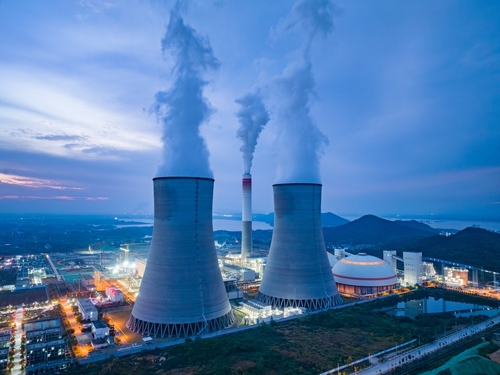
- On a hot, dry summer day the plume is short or absent. Why? Which psychrometric property of the ambient air determines this?炎熱乾燥的夏日,羽罼短小或消失。為什麼?環境空氣的哪一項濕空氣性質決定了這件事?
- Write the makeup-water expression $\dot m_5 = \dot m_a(\omega_4 - \omega_3)$ in words. What does each term represent physically?以文字寫出補充水式 $\dot m_5 = \dot m_a(\omega_4 - \omega_3)$。每一項在物理上代表什麼?
- If a plant operator reports the tower is "losing more water than usual" on a humid overcast day, is that expected? Explain.若廠區操作員回報在潮濕陰天冷却塔「比平常損耗更多水」,這合理嗎?請說明。
- The hot dry ambient air absorbs the exhaust vapour without saturating. The plume forms only when the humid warm exhaust mixes with cooler ambient air and the mixture crosses the dew point. On a hot dry day, ambient dew point is very low and the exhaust simply dilutes into unsaturated air — no plume. The key property is the ambient humidity ratio ω.炎熱乾燥的環境空氣能吸收排出蒸氣而不達飽和。羽罼只有在潮濕溫暖的排出氣與較冷環境空氣混合、且混合物跨過露點時才形成。炎熱乾燥日,環境露點很低,排出氣僅是稀釋進未飽和空氣 — 無羽罼。關鍵性質是環境的濕度比 ω。
- In words: (makeup flow) = (dry-air flow through tower) × (humidity ratio leaving − humidity ratio entering). Each Δω represents kilograms of water evaporated per kilogram of dry air; multiplying by ṁa gives total evaporation rate, which must be replaced.文字表述:(補充水流量)=(流經冷却塔的乾空氣流量)×(出口濕度比 − 入口濕度比)。每一 Δω 代表每公斤乾空氣所蒸發的水公斤數;乘以 ṁa 即得總蒸發率,這必須被補回。
- No — less water is lost on a humid day, not more. High ambient ω means ω₄ − ω₃ is smaller, so less evaporation occurs. The operator may be confusing a larger visible plume (more common on cool/humid days because saturation is reached earlier) with actual water loss, which is lower. Genuine excess loss points to drift (wind carrying liquid droplets out), not evaporation.不合理 — 潮濕日損水較少而非較多。環境 ω 高,表示 ω₄ − ω₃ 較小,故蒸發較少。操作員可能是將較大的可見羽罼(凉爽潮濕日因較早達飽和而更明顯)誤認為實際損水,實際損水反而較低。真正的超量損水應指向飄逸(風將液滴帶出),而非蒸發。
Practice problems練習題
Work each one yourself first, then reveal the solution step by step.請先自行作答,再逐步展開解答。