What you'll be able to do本章學習成果
- State the second law three ways — Clausius, Kelvin–Planck, and entropy — and explain internally reversible processes and the Kelvin temperature scale.
- List the common irreversibilities of engineering practice.
- Assess power, refrigeration, and heat-pump cycles against their reversible (Carnot) limits.
- Interpret the Clausius inequality to decide whether a cycle is reversible, irreversible, or impossible.
Key equations重要公式
Why a second law?為何需要第二定律?
Conservation of mass and energy tell you the disposition of mass and energy in a process — but not whether the process can actually happen. A cup of coffee never spontaneously reheats itself by drawing energy from the cooler room, even though energy would be perfectly conserved if it did. The second law is the guiding principle for which direction processes run. It also lets us establish equilibrium conditions, define an absolute temperature scale, and pin down the best theoretical performance any device can reach.
Three statements, one law
No single sentence captures the whole second law; three classic formulations are equivalent:沒有任何一句話能完整表達第二定律;以下三種經典陳述彼此等價:
It is impossible for any system to operate so that the sole result is energy transfer by heat from a cooler to a hotter body.任何系統都不可能以「唯一結果」為熱量由低溫物體傳至高溫物體的方式運作。
Heat flows downhill in temperature on its own: hot coffee cools to room temperature, but a cup at room temperature never heats itself by drawing energy from the air. The key phrase is sole result. A refrigerator does move heat from the cold interior to the warm kitchen, but only because a compressor supplies work $W_{in}$. Heat goes uphill only if something else in the surroundings changes to pay for it.熱量會自然地由高溫流向低溫:熱咖啡會冷卻到室溫,但室溫的杯子永遠不會自行從空氣吸熱而變熱。關鍵字是「唯一結果」。冰箱確實把熱從冷的內部送到溫暖的廚房,但那是因為壓縮機提供了功 $W_{in}$。熱量要「往上」流,外界必須有其他改變來付出代價。
It is impossible for any system to operate in a cycle and deliver net work to its surroundings while exchanging heat with only a single thermal reservoir.任何系統都不可能在循環中只與單一熱庫交換熱量,而對外界輸出淨功。
Every heat engine must reject some heat to a colder reservoir; it cannot turn all the heat it receives into work, so $\eta < 100\,\%$. A ship cannot run by drawing heat from the ocean and turning it all into propulsion. The word cycle matters: a single process can convert heat entirely to work (an ideal gas expanding isothermally), but the gas ends up at a larger volume. To repeat the process you must compress it back, and that step requires rejecting heat to a colder body.每部熱機都必須把部分熱量排放到較冷的熱庫;不可能把吸收的熱全部轉為功,因此 $\eta < 100\,\%$。船不可能只從海洋吸熱並全部轉為推進力。「循環」一詞很重要:單一過程可以把熱完全轉為功(理想氣體等溫膨脹),但氣體體積變大了。要重複這個過程就必須把它壓縮回去,而這一步必須向較冷的物體排熱。
The two statements are equivalent. Suppose a device violated Clausius, pumping heat $Q_C$ from cold to hot for free. Pair it with an ordinary engine that rejects exactly $Q_C$ to the same cold reservoir. The cold reservoir now has no net change, and the combination takes heat from the hot reservoir alone and produces work, which violates Kelvin–Planck. The reverse argument works too, so breaking either statement breaks the other.兩種陳述是等價的。假設某裝置違反克勞修斯陳述,能免費把熱 $Q_C$ 由冷處送到熱處。將它與一部正好向同一冷熱庫排放 $Q_C$ 的普通熱機組合。冷熱庫淨變化為零,組合後的系統只從熱熱庫吸熱並輸出功——違反克耳文–蒲朗克陳述。反向論證同樣成立,因此違反其中一個就必然違反另一個。
It is impossible for any process to decrease the total entropy of a system and its surroundings. Entropy is produced — never destroyed — whenever irreversibilities are present, and stays constant only in the reversible limit.任何過程都不可能使系統與外界的總熵減少。只要有不可逆性存在,熵就會產生——永不消滅;僅在可逆極限下保持不變。
$\sigma > 0$ for irreversible processes, $\sigma = 0$ for reversible ones, $\sigma < 0$ is impossible. (Physical meaning in the next section; calculation in the Entropy chapter.)不可逆過程 $\sigma > 0$,可逆過程 $\sigma = 0$,$\sigma < 0$ 不可能發生。(物理意義見下一節;計算見熵章節。)
Physical meaning of entropy熵的物理意義
What does the entropy statement actually say is increasing? Picture a crowd. When everyone pushes the same way, their combined motion moves a heavy crate — useful work. Let the same people run in random directions with the same energy: their pushes cancel and the crate stays put. Molecules behave the same way. Energy in organized form (a moving piston, a spinning shaft) can do work; the same energy scattered as random molecular motion mostly cannot.熵的陳述所說「增加」的究竟是什麼?想像一群人。當大家朝同一方向推,合力能推動沉重的木箱——這就是有用功。若同一群人以相同能量朝隨機方向奔跑,推力互相抵消,木箱不動。分子也是如此:有組織形式的能量(移動的活塞、轉動的軸)可以作功;同樣的能量散布成隨機分子運動,大多無法作功。
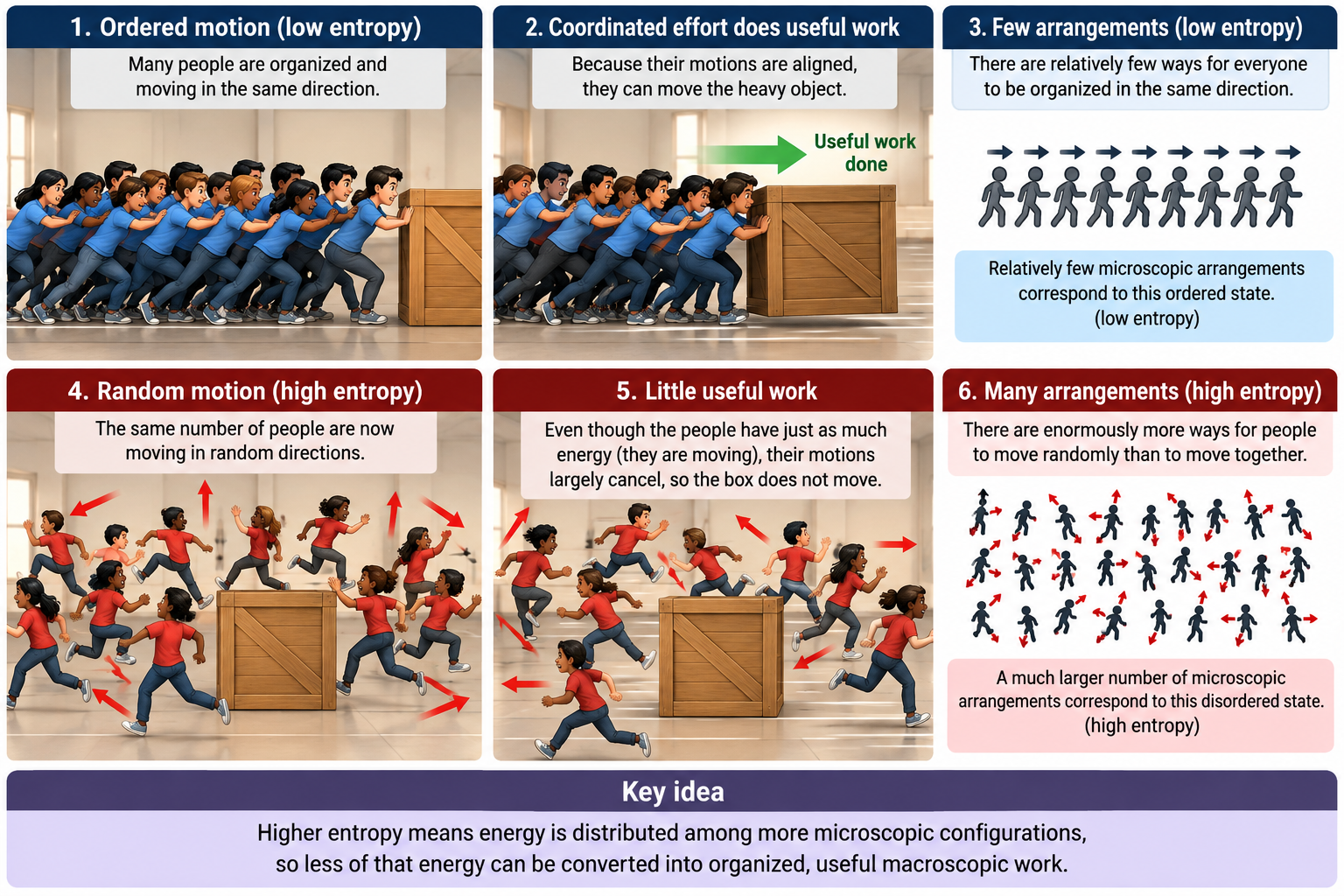
Boltzmann's entropy波茲曼熵
Statistical mechanics makes the counting exact. A macrostate (fixed $U$, $V$, $N$) can be realized by many microstates — distinct ways of assigning positions and energies to the molecules. Boltzmann tied entropy to that count:統計力學將這種計數精確化。一個巨觀狀態(固定 $U$、$V$、$N$)可由許多微觀狀態實現——即分子位置與能量的不同分配方式。波茲曼將熵與此數目連結:
- $\Omega$ — number of microstates: the count of distinct molecular arrangements that all look like the same measured state (see below).$\Omega$——微觀狀態數:所有看起來是同一量測狀態的不同分子排列方式之數目(見下文)。
- The logarithm makes $S$ extensive: combining two systems multiplies $\Omega$ ($\Omega_A\Omega_B$) but adds $S$ ($S_A+S_B$).對數使 $S$ 成為廣延量:兩系統合併時 $\Omega$ 相乘($\Omega_A\Omega_B$),$S$ 相加($S_A+S_B$)。
- Systems drift toward higher entropy simply because high-$\Omega$ macrostates are overwhelmingly more probable — the second law is a statement about odds.系統趨向高熵,只因高 $\Omega$ 的巨觀狀態機率壓倒性地大——第二定律是關於機率的敘述。
What Ω countsΩ 在計算什麼
Separate two ideas. A macrostate is what we can measure: $T$, $p$, how much gas is in each half of a tank. A microstate is one exact assignment of every molecule — which molecule is where, moving how fast. Many different microstates look identical from the outside. $\Omega$ is simply how many microstates produce the same macrostate.先區分兩個概念。巨觀狀態是可以量測的:$T$、$p$、槽內左右兩半各有多少氣體。微觀狀態則是每個分子的確切安排——哪個分子在哪裡、速度多少。許多不同的微觀狀態從外部看起來完全相同。$\Omega$ 就是產生同一個巨觀狀態的微觀狀態數目。
Take the smallest possible example: four labelled molecules A–D in a box with an imaginary line down the middle. The macrostate is just "how many on the left | right". Listing every arrangement:以最小的例子說明:四個標記為 A–D 的分子在盒子中,中間畫一條假想線。巨觀狀態只是「左邊幾個 | 右邊幾個」。列出所有排列:
With 4 molecules the odds are only 6 to 1. With 100 molecules, $\Omega$ for a 50 | 50 split is about $10^{29}$ while "all on the left" is still exactly 1. A real gas has ~$10^{23}$ molecules, so the spread-out state is not just likely — it is effectively certain. That is why gas fills its container and never gathers itself back into one corner.4 個分子時機率比只有 6 比 1。100 個分子時,50 | 50 的 $\Omega$ 約為 $10^{29}$,而「全部在左邊」仍然只有 1。真實氣體約有 $10^{23}$ 個分子,均勻分佈不只是可能——而是幾乎必然。這就是氣體會充滿容器、而永遠不會自行聚回角落的原因。
These counts are astronomically large, which is why Boltzmann takes the logarithm: $\ln\Omega$ turns a number with $10^{23}$ digits into something of ordinary size, and $k_B$ converts it to J/K.這些數目大得驚人,因此波茲曼取對數:$\ln\Omega$ 把位數達 $10^{23}$ 的數字變成一般大小,再以 $k_B$ 換算成 J/K。
Thermal reservoirs熱力學熱庫
A thermal reservoir stays at constant temperature no matter how much energy is added or removed by heat transfer. The atmosphere, oceans and lakes, or a large block of copper all approximate one. Reservoirs give us fixed hot and cold temperatures to analyze cycles against.
Irreversibilities不可逆性
Actual processes differ from idealized ones through irreversibilities. The common ones in engineering:
- Heat transfer across a finite temperature difference
- Unrestrained (free) expansion to lower pressure
- Spontaneous chemical reaction and mixing
- Friction — sliding and fluid
- Electric current through a resistance; hysteresis; inelastic deformation
A process is reversible if no irreversibilities exist in either the system or surroundings (a full idealization). It is internally reversible if none exist within the system — a quasi-equilibrium process — even if external ones (like heat transfer across a gap) do. All real processes are irreversible.
Kelvin–Planck, quantified克耳文–蒲朗克陳述的量化
For any system undergoing a cycle while exchanging heat with a single reservoir, the net work can only be negative or zero — never positive:
For a power cycle between two reservoirs, efficiency is the fraction of $Q_H$ converted to work:
The law forces $\eta < 100\%$: some heat must always be discharged to the cold reservoir.
Carnot corollaries卡諾推論
Two deductions from Kelvin–Planck shape everything that follows:
- An irreversible power cycle always has lower efficiency than a reversible one operating between the same two reservoirs.
- All reversible cycles between the same two reservoirs have the same efficiency — independent of working fluid or mechanism.
The same logic applies to refrigeration and heat-pump cycles in terms of their coefficients of performance.
Maximum performance最大性能
Because reversible cycles set the ceiling, and (by the Kelvin scale) the reversible heat-transfer ratio equals the temperature ratio $Q_C/Q_H = T_C/T_H$, the maximum theoretical measures depend only on reservoir temperatures (in Kelvin):
These are the Carnot limits for the power, refrigeration, and heat-pump cycles respectively. No real device beats them.
Carnot & Clausius explorer卡諾與克勞修斯探索器
Set the reservoir temperatures and energy transfers for a power cycle, refrigerator, or heat pump. The schematic scales its arrows to the energies, and the verdict tells you whether your numbers describe a reversible, irreversible, or impossible cycle — by comparing to the Carnot limit and computing the Clausius cyclic integral $\sigma_{cycle}$.
Try TH = 500 K, TC = 300 K, Q_H = 1000 kJ. Q_C = 600 kJ is exactly reversible; Q_C = 400 kJ is impossible; Q_C = 700 kJ is irreversible.
The Carnot cycle卡諾循環
The Carnot cycle is a concrete reversible cycle between two reservoirs: four internally reversible processes — two isothermal alternating with two adiabatic. Run forward it is a power cycle with $\eta = 1 - T_C/T_H$; run backward, the same energy transfers reverse direction, giving a Carnot refrigerator or heat pump with the COP limits above. (The Stirling and Ericsson cycles are other reversible benchmarks.)
The Clausius inequality克勞修斯不等式
Applicable to any cycle, the Clausius inequality is the bridge to entropy:
where the integral runs over the whole boundary and the whole cycle. The sign of $\sigma_{cycle}$ classifies the cycle:
- $\sigma_{cycle} = 0$ — no internal irreversibilities (reversible)
- $\sigma_{cycle} > 0$ — irreversibilities present
- $\sigma_{cycle} < 0$ — impossible
The explorer above computes exactly this quantity for the cycle you dial in.
Is the cycle possible?此循環是否可能存在?
Example範例 Power cycle vs. the Carnot limit動力循環與卡諾極限比較 ›
Given: a power cycle receives 1000 kJ at $T_H=500$ K and rejects 600 kJ at $T_C=300$ K.
Find: whether it is reversible, irreversible, or impossible.
Solution. Actual $\eta=1-600/1000=0.40$. Carnot limit $\eta_{max}=1-300/500=0.40$. Since $\eta=\eta_{max}$, the cycle is reversible. Check Clausius: $\sigma=\tfrac{600}{300}-\tfrac{1000}{500}=0$. ✓