What you'll be able to do本章學習成果
- Analyze the reheat cycle and explain how it keeps turbine-exit quality high.分析再熱循環,並解釋它如何維持渦輪機出口的高乾度。
- Analyze a regenerative cycle with an open feedwater heater and find the extraction fraction $y$.分析含開式給水加熱器的再生循環,並求出抽汽分率 $y$。
- Describe closed feedwater heaters and where each type is used.說明閉式給水加熱器,以及各類型的使用場合。
- Explain cogeneration and the combined gas–vapor cycle and why they raise fuel utilization.解釋熱電共生與燃氣-蒸汽複合循環,及其為何能提高燃料利用率。
Builds on the simple cycle in Vapor Power Cycles.建立在蒸汽動力循環一章簡單循環的基礎之上。
Key equations重要公式
The reheat cycle再熱循環
Higher boiler pressure raises efficiency but pushes the turbine-exit state into the wet region, where liquid droplets erode blades. Reheat sidesteps the trade-off: expand the steam partway, send it back to the steam generator to be reheated, then finish the expansion in a second turbine stage.提高鍋爐壓力可提升效率,卻會將渦輪機出口狀態推入濕區,液滴會侵蝕葉片。再熱巧妙避開了這個取捨:讓蒸汽先膨脹一部分,送回蒸汽產生器再加熱,再於第二段渦輪機完成膨脹。
- 6–1 Heat addition in the steam generator (economizer → boiler → superheat).6–1 在蒸汽產生器中加熱(節熱器 → 鍋爐 → 過熱)。
- 1–2 Expansion through the high-pressure (HP) turbine.1–2 通過高壓(HP)渦輪機膨脹。
- 2–3 Reheat at constant pressure back in the steam generator.2–3 回到蒸汽產生器中定壓再熱。
- 3–4 Expansion through the low-pressure (LP) turbine.3–4 通過低壓(LP)渦輪機膨脹。
- 4–5 Heat rejection in the condenser.4–5 在冷凝器中排熱。
- 5–6 Compression in the feed pump.5–6 在給水泵中壓縮。
Each numbered point is a state, fixed by its pressure and enthalpy:每個編號點都是一個狀態,由其壓力與焓所確定:
| State狀態 | Where it is位置 | Condition狀況 |
|---|---|---|
| 1 | HP turbine inlet (steam-generator exit)高壓渦輪機入口(蒸汽產生器出口) | Superheated steam at boiler pressure — highest pressure and temperature.鍋爐壓力下的過熱蒸汽——壓力與溫度皆為最高。 |
| 2 | HP turbine exit = reheat inlet高壓渦輪機出口=再熱入口 | Partly expanded steam at the intermediate reheat pressure.在中間再熱壓力下部分膨脹的蒸汽。 |
| 3 | Reheat exit = LP turbine inlet再熱出口=低壓渦輪機入口 | Reheated steam — back near the peak temperature, still at the reheat pressure.再熱後的蒸汽——回到接近峰值溫度,壓力仍為再熱壓力。 |
| 4 | LP turbine exit = condenser inlet低壓渦輪機出口=冷凝器入口 | Low-pressure steam at high quality (kept dry by the reheat).低壓蒸汽,乾度高(因再熱而保持乾燥)。 |
| 4′ | LP exit without reheat (hypothetical)無再熱時的低壓出口(假想) | Same condenser pressure, but lower quality — wetter, which erodes the blades.冷凝器壓力相同,但乾度較低——更濕,會侵蝕葉片。 |
| 5 | Condenser exit = pump inlet冷凝器出口=泵入口 | Saturated liquid at condenser pressure.冷凝器壓力下的飽和液體。 |
| 6 | Pump exit = steam-generator inlet泵出口=蒸汽產生器入口 | Compressed liquid raised back to boiler pressure.壓縮液體,壓力提升回鍋爐壓力。 |
Because the second expansion starts from a high-temperature, lower-pressure state, the exit (state 4) lands at higher quality than it would without reheat (state 4′). Efficiency must account for work from both stages and heat added in both the original vaporization/superheat and the reheat:由於第二段膨脹從高溫、較低壓力的狀態開始,其出口(狀態 4)的乾度高於無再熱時(狀態 4′)。計算效率時必須同時計入兩段渦輪機的功,以及原始汽化/過熱與再熱兩次加入的熱量:
Supercritical reheat超臨界再熱
Decades of improvement in materials and fabrication have raised allowable steam-generator temperatures and pressures. In the supercritical reheat cycle, steam generation (process 6–1) occurs above water's critical pressure: there is no distinct boiling phase change — water in the tubes is heated continuously from liquid to vapor without bubbling. These plants reach the highest efficiencies in service.數十年來材料與製造技術的進步,提高了蒸汽產生器可容許的溫度與壓力。在超臨界再熱循環中,蒸汽產生(過程 6–1)發生於水的臨界壓力之上:沒有明顯的沸騰相變——管內的水從液體連續加熱為蒸氣,不產生氣泡。這類電廠達到現役最高的效率。
Plants are graded by their main-steam pressure and temperature. Subcritical stays below the critical pressure (<22.06 MPa) and boils in the dome. Supercritical (SC) runs above it (~24–25 MPa, ~540–565 °C) with no boiling plateau. Ultra-supercritical (USC) pushes both further — typically ≈ 25–30 MPa and ≈ 600 °C steam (with ~600 °C reheat).電廠依主蒸汽壓力與溫度分級。亞臨界低於臨界壓力(<22.06 MPa),在穹頂內沸騰;超臨界(SC)高於臨界壓力(約 24–25 MPa、約 540–565 °C),無沸騰平台;超超臨界(USC)則將兩者同時再往上推——約 25–30 MPa、約 600 °C(再熱亦約 600 °C)。
The “ultra” tag is not a new physics regime — it just means going beyond ordinary supercritical conditions to still-higher temperature and pressure. Because efficiency tracks the average temperature of heat addition, every extra degree helps: USC units reach ≈ 45–50% efficiency (vs ~37–40% subcritical), burning less fuel and emitting less CO₂ per kWh. The ceiling is set by materials — “ultra” conditions demand advanced nickel-based alloys that withstand ~600 °C; research-stage advanced-USC (A-USC) targets ~700 °C and ~35 MPa.「超超」並非新的物理範疇——只是把條件推得比一般超臨界更高的溫度與壓力。由於效率隨平均加熱溫度提升,每多一度都有幫助:USC 機組效率達約 45–50%(亞臨界約 37–40%),每度電耗用更少燃料、排放更少 CO₂。其上限取決於材料——「超超」條件需要能耐約 600 °C 的先進鎳基合金;研究階段的先進超超臨界(A-USC)目標約 700 °C、約 35 MPa。
Regeneration with an open feedwater heater以開式給水加熱器進行再生
The simple cycle adds heat to cold feedwater across a large temperature gap — thermodynamically wasteful. Regenerative feedwater heating bleeds a fraction of partly-expanded steam from the turbine to preheat the feedwater, raising the average temperature of heat addition and thus efficiency.簡單循環跨越很大的溫差將熱量加給低溫給水——就熱力學而言相當浪費。再生給水加熱從渦輪機抽出一部分已部分膨脹的蒸汽來預熱給水,提高加熱的平均溫度,從而提升效率。
An open feedwater heater is a direct-contact mixing chamber. Follow a unit of mass: it enters the turbine at 1; at the extraction pressure a fraction $y$ is diverted (state 2) to the heater, while $(1-y)$ continues to the condenser (state 3), is pumped to state 5, and enters the heater too. The streams mix and leave as saturated liquid (state 6), which a second pump raises to boiler pressure (state 7). A mass and energy balance on the adiabatic heater fixes the extraction fraction:開式給水加熱器是一個直接接觸的混合室。追蹤單位質量:它於 1 進入渦輪機;在抽汽壓力下,比例 $y$ 被分流(狀態 2)至加熱器,其餘 $(1-y)$ 繼續流向冷凝器(狀態 3),泵送至狀態 5 後也進入加熱器。兩股流體混合後以飽和液體離開(狀態 6),再由第二個泵升壓至鍋爐壓力(狀態 7)。對絕熱加熱器作質量與能量平衡即可確定抽汽分率:
Per unit mass entering the first turbine stage, the work and heat then become:以進入第一段渦輪機的單位質量計,功與熱則成為:
Closed feedwater heaters閉式給水加熱器
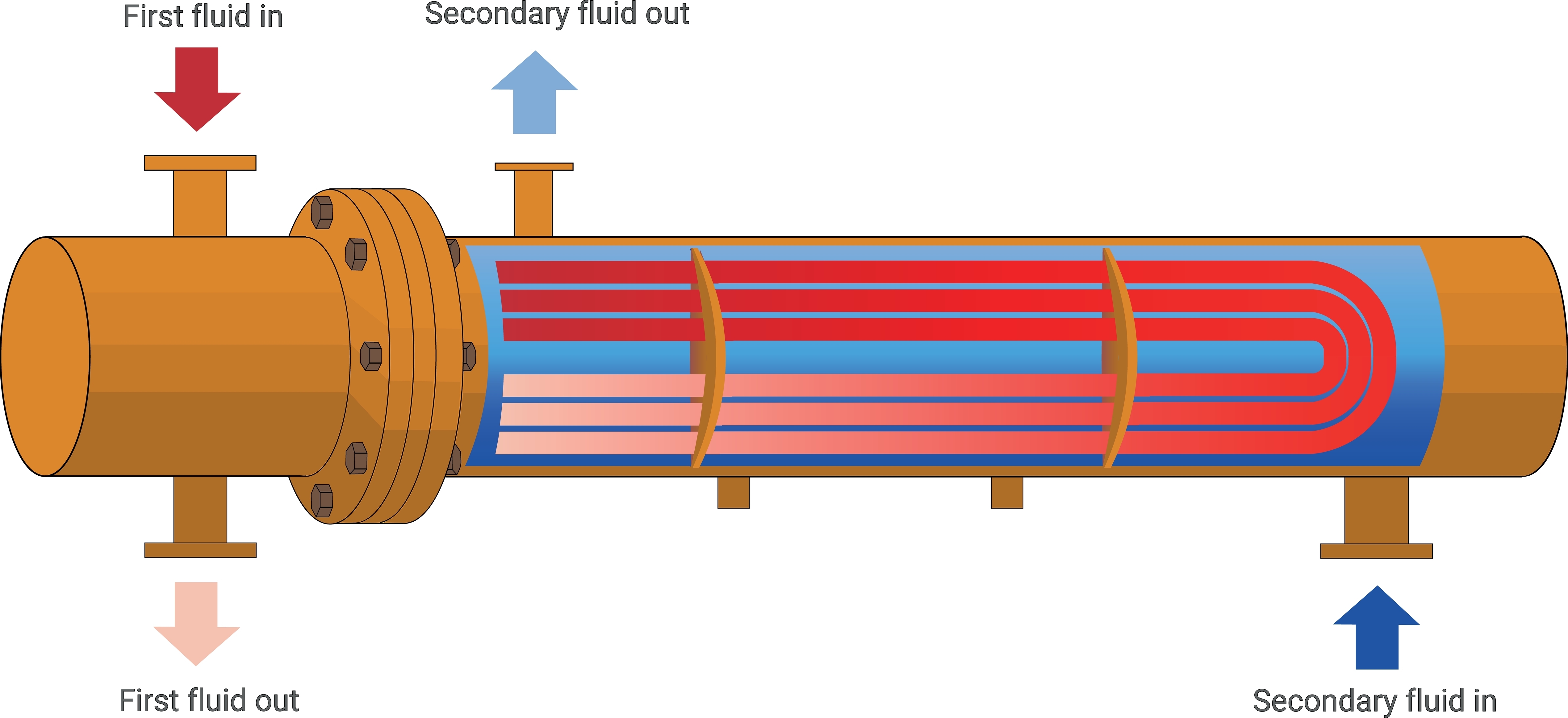
A closed feedwater heater is a shell-and-tube exchanger: the extracted steam and the feedwater do not mix — they're at different pressures, so no extra pump is needed for the feedwater stream. The condensed extraction (drain) is either pumped forward or cascaded (trapped) back to a lower-pressure heater. Real plants string several open and closed heaters in series; a single open "deaerating" heater is usually included to strip dissolved gases.閉式給水加熱器是殼管式熱交換器:抽出的蒸汽與給水不混合——兩者壓力不同,因此給水流不需要額外的泵。冷凝後的抽汽(疏水)或以泵前送,或經疏水閥逐級洩放(cascade)至較低壓力的加熱器。實際電廠將多個開式與閉式加熱器串聯使用;通常會包含一個開式「除氧」加熱器以去除溶解氣體。
Reheat & regeneration explorer再熱與再生探索器
Switch between the three modifications. In Reheat mode, set the reheat pressure and watch the turbine-exit quality stay high (compare the "without reheat" note). In the Regenerative modes, set the extraction pressure and read the bleed fraction $y$ and the efficiency gain over the simple cycle — the open heater mixes the streams (needing a second pump), while the closed heater keeps them separate and cascades its drain back to the condenser.在三種改善方法之間切換。在再熱模式下,設定再熱壓力,觀察渦輪機出口乾度維持高值(對照「無再熱」標註)。在再生模式下,設定抽汽壓力,讀取抽汽分率 $y$ 與相對簡單循環的效率增益——開式加熱器混合兩股流體(需要第二個泵),閉式加熱器則保持分離,並將疏水逐級洩放回冷凝器。
Teaching steam model (compact table + $c_p\approx2.1$ kJ/kg·K superheat). Numbers are representative, not table-exact.教學用蒸汽模型(精簡蒸汽表 + 過熱區 $c_p\approx2.1$ kJ/kg·K)。數值具代表性,非精確查表值。
Cogeneration熱電共生
Cogeneration systems are integrated plants that deliver two valuable products from one fuel input: electricity and process steam (or hot water). The classic application is district heating — supplying steam or hot water for space heating to homes, businesses, and industry alongside electric power.熱電共生系統是一種整合式電廠,從單一燃料輸入提供兩種有價值的產品:電力與製程蒸汽(或熱水)。經典的應用是區域供暖——在供電之餘,為住家、商業與工業供應暖氣用的蒸汽或熱水。
Taiwan's hot climate means there is essentially no district-heating demand — so cogeneration here works the other way around. The steam is the locally consumed product: factories (petrochemical, paper, textile, food processing) use it on-site for process heating and chemical processes. The electricity is what travels: beyond powering the plant itself, the surplus is fed into the grid for distribution to the public.台灣氣候炎熱,幾乎沒有區域供暖的需求——因此這裡的熱電共生恰好相反。蒸汽是就地消耗的產品:工廠(石化、造紙、紡織、食品加工)在廠內將其用於製程加熱與化學程序。電力才是外送的產品:除供廠內自用外,剩餘電力饋入電網,供大眾使用。
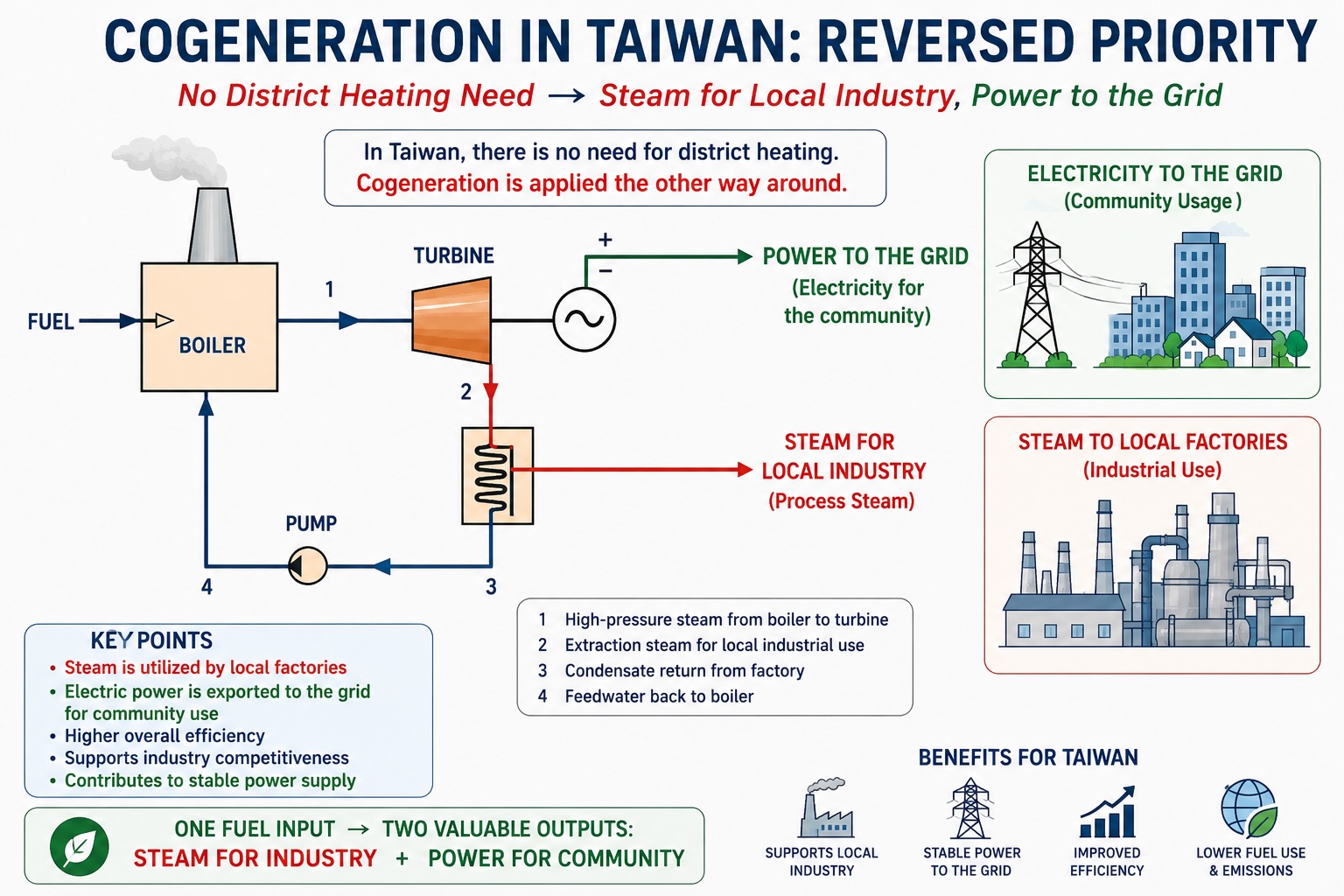
Exporting useful steam limits the electricity obtainable from a given fuel input. To deliver saturated vapor at 100 °C (1 atm) to customers, the plant must condense at a higher temperature — and thus higher pressure — than a power-only plant that condenses below 1 atm. Electric efficiency drops, but total fuel utilization rises because the rejected heat becomes a useful product instead of waste.輸出有用的蒸汽會限制同樣燃料輸入所能獲得的電力。要向用戶供應 100 °C(1 atm)的飽和蒸汽,電廠的冷凝溫度——亦即冷凝壓力——必須高於在 1 atm 以下冷凝的純發電廠。發電效率因此下降,但總燃料利用率上升,因為排出的熱量成了有用的產品而非廢熱。
The combined gas–vapor cycle燃氣-蒸汽複合循環
A combined cycle stacks a gas turbine (Brayton, the "topping" cycle) on top of a Rankine plant (the "bottoming" cycle). The gas turbine's hot exhaust — normally a major loss — passes through a heat-recovery steam generator (HRSG) that boils water for the steam cycle, instead of burning extra fuel:複合循環將燃氣渦輪機(布雷頓,「頂部」循環)疊在朗肯電廠(「底部」循環)之上。燃氣渦輪機的高溫廢氣——原本是一大損失——通過廢熱回收蒸汽產生器(HRSG)為蒸汽循環煮水,而不需燃燒額外燃料:
Because the Brayton cycle adds heat at very high temperature and the Rankine cycle rejects it at low temperature, the combination spans a huge temperature range — modern combined-cycle plants exceed 60% thermal efficiency, the highest of any heat engine in commercial service.由於布雷頓循環在極高溫度下加熱、朗肯循環在低溫下排熱,兩者的組合涵蓋了巨大的溫度範圍——現代複循環電廠的熱效率超過 60%,是商業運轉中所有熱機之最。
Taiwan Power Company reports the low-heating-value (LHV) gross efficiency of each class of thermal unit. The combined cycle (複循環機組) leads every other technology — and the lead is widening as new units enter service.台灣電力公司公布各類火力機組的低熱值(LHV)毛效率。複循環機組領先所有其他技術——且隨著新機組投入運轉,領先幅度持續擴大。
| Generating technology發電技術 | 2016 | 2025 |
|---|---|---|
| Combined cycle · 複循環機組 | 50.9% | 56.0% |
| Diesel engine · 柴油機 | 41.1% | 41.1% |
| Steam (conventional) · 汽力機組 | 39.7% | 40.4% |
| Gas turbine, simple cycle · 氣渦輪機組 | 26.7% | 32.4% |
| All thermal — fleet average · 全火力機組 | 43.7% | 48.7% |
Source: Taipower, 低熱值毛效率 (LHV gross efficiency). ROC years 105–114 = 2016–2025; combined cycle has been the highest every year in that span.來源:台電〈低熱值毛效率〉。民國 105–114 年=2016–2025 年;該期間內複循環每年皆為最高。
Extraction fraction for an open FWH開式給水加熱器的抽汽分率
Example範例 Bleed fraction in a regenerative cycle再生循環中的抽汽分率 ›
Given: in an open-FWH cycle, the extracted steam has $h_2 = 2700$ kJ/kg; the feedwater entering the heater from the condenser pump is $h_5 = 175$ kJ/kg; saturated liquid leaves the heater at $h_6 = 605$ kJ/kg.已知:在一開式給水加熱器循環中,抽出蒸汽 $h_2 = 2700$ kJ/kg;由冷凝器泵進入加熱器的給水 $h_5 = 175$ kJ/kg;離開加熱器的飽和液體 $h_6 = 605$ kJ/kg。
Find: the fraction $y$ of steam that must be extracted.求:必須抽出的蒸汽分率 $y$。
Solution. Energy balance on the adiabatic heater, $y\,h_2 + (1-y)h_5 = h_6$:解:對絕熱加熱器作能量平衡,$y\,h_2 + (1-y)h_5 = h_6$: $$y = \frac{h_6 - h_5}{h_2 - h_5} = \frac{605 - 175}{2700 - 175} = \frac{430}{2525} = 0.170.$$ So about 17% of the flow is bled to the heater; the remaining 83% goes through the condenser.故約 17% 的流量被抽至加熱器;其餘 83% 流經冷凝器。
Practice problems練習題
Work each one yourself first, then reveal the solution step by step.請先自行解題,再逐步展開詳解。