What you'll be able to do本章學習成果
- Explain the four-component Rankine cycle and sketch its schematic and T–s diagram.
- Apply mass and energy balances to the turbine, condenser, pump, and evaporator (the steam/water-side heat exchanger).
- Determine thermal efficiency, net power, back-work ratio, and mass flow rates.
- Predict how evaporator pressure, condenser pressure, superheat, and reheat shift performance — and where irreversibilities bite.
Key equations重要公式
The vapor power plant蒸汽動力廠
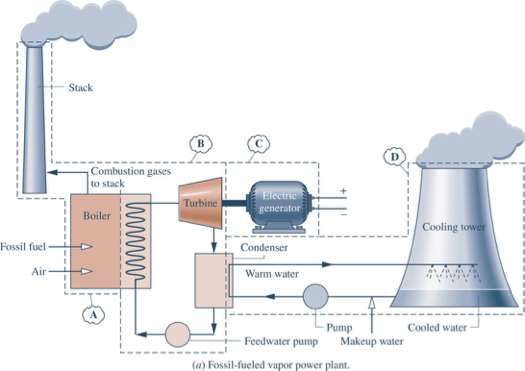
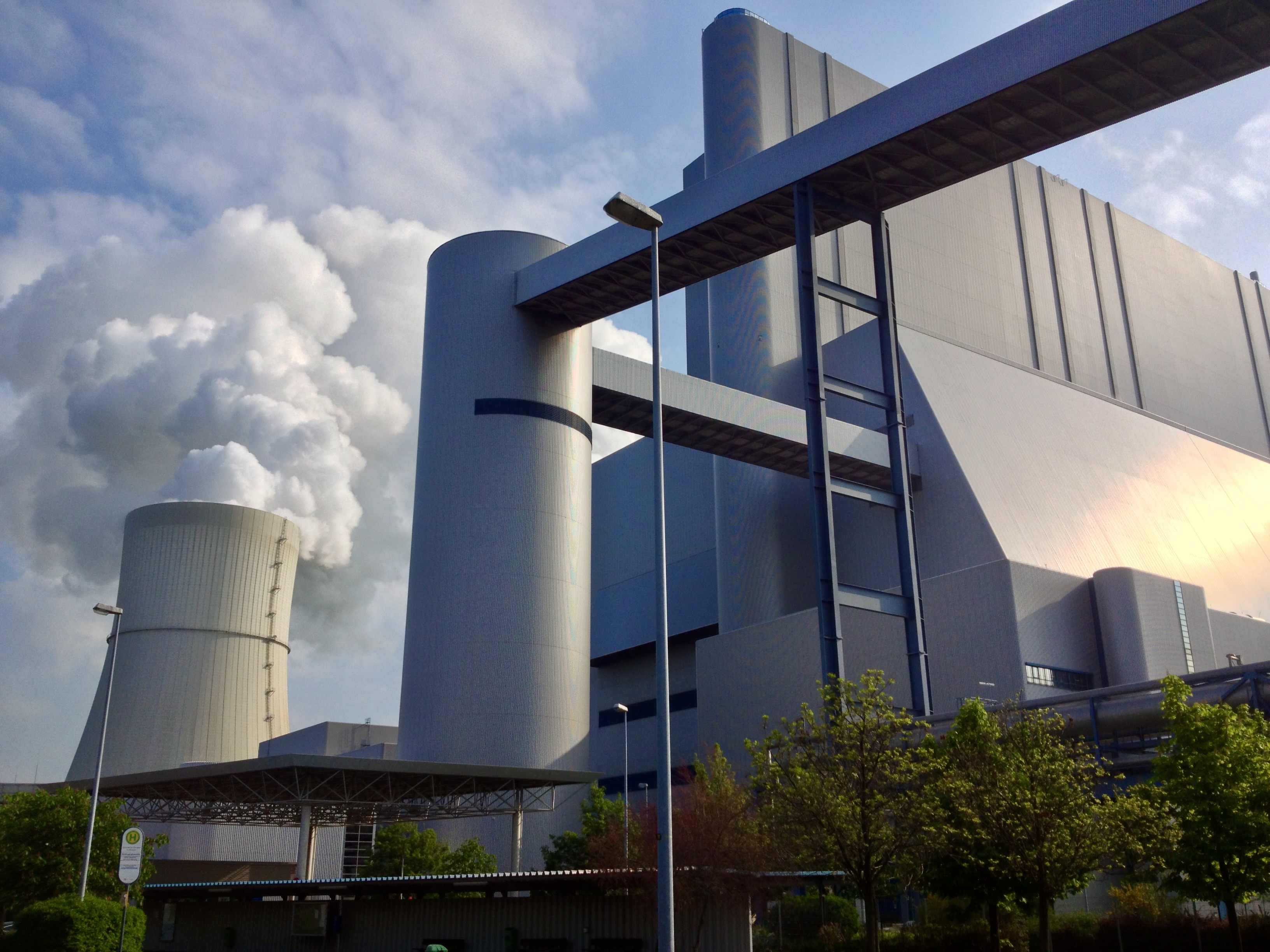
Fossil-fueled, nuclear, concentrating-solar, and geothermal plants share the same thermodynamic skeleton — they differ mainly in where the energy to boil the water comes from. A representative fossil plant breaks into four subsystems: the heat source (A), the working-fluid loop (B), the electric generator (C), and the cooling/condenser side (D). Each unit of water circulating through loop B undergoes the Rankine cycle.
The first law sets net work equal to net heat: $\dot W_{cycle} = \dot Q_{in} - \dot Q_{out}$. The second law caps efficiency below 100%. Efficiency rises as the average temperature of heat addition increases and the average temperature of heat rejection decreases. Today's plants reach ~40%; supercritical designs exceed 47%.
Why we say evaporator, not boiler為何稱「蒸發器」而非「鍋爐」
A power-plant boiler is really two systems sharing a wall. On one side, fuel burns and hot flue gas flows — the fire side. On the other, the working fluid is heated, boiled, and superheated — the steam/water side. The thermodynamic cycle only ever touches the second one: the working fluid never enters the furnace, so combustion is a heat source, not a cycle state. The component the cycle actually contains is the steam/water-side heat exchanger — the evaporator (with its economizer and superheater passes). That is why we label process 4→1 the evaporator throughout this chapter.電廠的鍋爐其實是共用一面壁的兩個系統。一側燃料燃燒、熱煙氣流動——即火側;另一側則加熱、永騰、過熱工作流體——即水/水蒸氣側。熱力學循環只接觸後者:工作流體不進入爐祠,故燃燒是熱源而非循環狀態。循環真正包含的元件是水蒸氣側的換熱器——蒸發器(含省煤器與過熱器段)。這就是本章將過程 4→1 稱為蒸發器的原因。
The four components, in motion四個元件的運轉
The Rankine cycle is four control volumes joined in a loop — four processes, one per component:朗肯循環是四個控制體積首尾相連成一迴路——四個過程,每個元件一個:
- 1–2 Turbine: vapor expands, developing work.
- 2–3 Condenser: vapor condenses, rejecting heat to cooling water.
- 3–4 Pump: liquid is pressurized into the evaporator (work input).
- 4–1 Evaporator: liquid is heated to saturation and vaporized.
Follow a single packet of water around the closed loop. Press Play to watch it circulate, or Step through one process at a time — each leg names the device it passes through and its thermodynamic character: the turbine and pump are isentropic (entropy held constant), while the boiler and condenser exchange heat at constant pressure (isobaric).跟隨一包水在封閉迴路中循環。按下「播放」觀察它流動,或以「單步」逐一查看每個過程——每段都標示所經裝置及其熱力學特性:渦輪機與泵為等熵過程,鍋爐與冷凝器則在定壓下交換熱量(等壓)。
The cycle on a T–s diagramT–s 圖上的循環
Before putting numbers to anything, look at the cycle's shape. Each state 1–4 is a point; the loop is drawn against the saturation dome, and the area it encloses is the net work. Raise the evaporator pressure, drop the condenser pressure, and dial in superheat with the turbine-inlet temperature , or switch on reheat — and watch the diagram redraw. We quantify it in the next section.在量化之前,先看循環的形狀。狀態 1–4 各為一點;迴路繪於飽和穹頂上,所圍面積即淨功。提高蒸發器壓力、降低冷凝器壓力、以渦輪機入口溫度加入過熱,或開啟再熱——觀察圖形如何重繪。下一節再量化。
Teaching model using a compact saturated-steam table; superheat approximated with $c_p \approx 2.1$ kJ/kg·K. Numbers are representative, not table-exact.
Energy balances & performance能量平衡與性能
Now put numbers to each leg. Treating every component as a steady-state, adiabatic-where-applicable control volume and neglecting kinetic and potential energy, the per-unit-mass transfers are:現在為每段賦予數值。將每個元件視為穩態、適當處絕熱的控制體積並略去動能與位能,各單位質量的傳遞量為:
Derivation推導 The four transfers from one energy balance由單一能量平衡推導四個傳遞量 ›
1 · One control-volume balance for all four.1 · 四者共用的控制體積平衡。 Each component is a steady-state control volume with a single inlet and exit. The first law (energy rate balance), with kinetic and potential energy neglected, is the same for every one:每個元件都是具單一進、出口的穩態控制體積。略去動能與位能後,第一定律(能量變化率平衡)對每一個都相同:
Per unit mass, $\;\dot W_{cv}/\dot m = (h_{in}-h_{out}) + \dot Q_{cv}/\dot m$. Now specialize the two terms device by device.就單位質量而言,$\;\dot W_{cv}/\dot m = (h_{in}-h_{out}) + \dot Q_{cv}/\dot m$。接著逐一裝置代入。
2 · Turbine (1→2) and pump (3→4): adiabatic, work only.2 · 渦輪機(1→2)與泵(3→4):絕熱,僅有功。 Both exchange essentially no heat ($\dot Q_{cv}\approx 0$), so work equals the enthalpy drop. The turbine produces work; the pump consumes it (written as a positive input $\dot W_p=-\dot W_{cv}$):兩者幾乎不交換熱量($\dot Q_{cv}\approx 0$),故功等於焓降。渦輪機產生功;泵消耗功(記為正的輸入 $\dot W_p=-\dot W_{cv}$):
3 · Evaporator (4→1) and condenser (2→3): heat only, no work.3 · 蒸發器(4→1)與冷凝器(2→3):僅有熱,無功。 Neither has a shaft, so $\dot W_{cv}=0$ and heat equals the enthalpy change. Heat is added in the boiler and rejected in the condenser (so $\dot Q_{out}$ is written positive in the leaving direction):兩者皆無轉軸,故 $\dot W_{cv}=0$,熱量等於焓變。鍋爐加熱、冷凝器放熱(故 $\dot Q_{out}$ 以流出方向取正值):
4 · Check the loop closes.4 · 驗證迴路自洽。 Around the full cycle the enthalpy returns to its start, so the four transfers must satisfy $\dot W_t-\dot W_p = \dot Q_{in}-\dot Q_{out}$ — net work equals net heat, exactly the first law for a cycle. The efficiency $\eta=\dot W_{net}/\dot Q_{in}$ (Eq. 8.5) follows directly.繞行整個循環後焓回到起點,故四個傳遞量必滿足 $\dot W_t-\dot W_p = \dot Q_{in}-\dot Q_{out}$——淨功等於淨熱,正是循環的第一定律。效率 $\eta=\dot W_{net}/\dot Q_{in}$(式 8.5)即由此而來。
Two numbers carry the whole story of the cycle's performance. Keep them on separate lines — they answer different questions:兩個數字道盡循環性能的全貌。將它們分行列出——因為它們回答不同的問題:
Thermal efficiency.熱效率。 The numerator is the net work delivered — turbine output minus the work spent driving the pump. The denominator is the heat the boiler must add. So $\eta$ is the fraction of supplied heat actually turned into useful work: bigger is better.分子為淨輸出功——渦輪機輸出減去驅動泵所耗的功;分母為鍋爐須加入的熱量。因此 $\eta$ 即供入熱量真正轉換為有用功的比例:愈大愈好。
Back-work ratio.背功比。 The numerator is the work fed into the pump; the denominator is the gross work produced by the turbine. So bwr is the share of the turbine's output that must be recycled just to run the pump.分子為輸入泵的功;分母為渦輪機產出的總功。因此背功比即渦輪機輸出中,須回頭用來驅動泵的比例。
The back-work ratio is tiny for vapor plants — pumping a liquid costs less than 1% of turbine output, a key advantage over gas turbines.
The ideal Rankine cycle理想朗肯循環
The ideal cycle adds two assumptions: no pressure drop in evaporator or condenser (constant-pressure heat transfer), and isentropic turbine and pump. The four processes become two isentropics and two constant-pressure heat exchanges. Pump work, for a nearly incompressible liquid, is well approximated by:
Derivation推導 Pump work from energy conservation由能量守恆推導泵功 ›
1 · Start from the steady-flow energy balance.1 · 從穩態流動能量平衡開始。 Apply the first law to the pump as a control volume with one inlet (3) and one exit (4) at steady state:將第一定律套用於泵這個控制體積,於穩態下有一進口(3)與一出口(4):
2 · Drop the negligible terms.2 · 略去可忽略項。 A pump is well-insulated over its short flow path, so it is taken as adiabatic ($\dot Q_{cv}\approx 0$), and the kinetic- and potential-energy changes are negligible. Writing the work input as $\dot W_p = -\dot W_{cv}$:泵的流動路徑短且隔熱良好,視為絕熱($\dot Q_{cv}\approx 0$),且動能與位能變化可忽略。將功的輸入記為 $\dot W_p = -\dot W_{cv}$:
3 · Bring in the second-law property relation.3 · 引入第二定律的性質關係式。 The ideal pump is internally reversible and adiabatic, i.e. isentropic ($ds = 0$). The Gibbs ("T ds") relation $T\,ds = dh - v\,dp$ then collapses to $dh = v\,dp$, so the enthalpy rise is理想泵為內可逆且絕熱,即等熵($ds = 0$)。吉布斯($T\,ds$)關係式 $T\,ds = dh - v\,dp$ 因此簡化為 $dh = v\,dp$,故焓的增量為
4 · Use incompressibility.4 · 利用不可壓縮性。 The working fluid entering the pump is a saturated liquid, whose specific volume barely changes under compression. Treating $v \approx v_3$ as constant pulls it out of the integral:進入泵的工作流體為飽和液體,其比容在加壓下幾乎不變。將 $v \approx v_3$ 視為常數提出積分:
This is exactly Eq. 8.7b. It is why pump work can be estimated from pressures and one specific-volume value alone — no superheat table needed for state 4.這正是式 8.7b。因此泵功僅需由壓力與一個比容值即可估算——求狀態 4 不必查過熱表。
On the T–s diagram, the area under the evaporator process line is heat in, the area under the condenser line is heat out, and the enclosed cycle area is the net work.
Effects of evaporator and condenser pressure蒸發器與冷凝器壓力的影響
Lowering condenser pressure reduces the temperature of heat rejection, increasing efficiency. This is why condensers run well below atmospheric — the practical floor is the saturation pressure at ambient temperature. (A closed loop also lets plants use clean, non-corrosive demineralized water.)
Raising evaporator pressure increases the average temperature of heat addition, again increasing efficiency. The catch: it lowers the steam quality at turbine exit. Liquid droplets erode turbine blades — so there's a limit unless we intervene.
Superheat & reheat過熱與再熱
Superheat heats vapor beyond saturation before the turbine. It raises both the average temperature of heat addition (more efficiency) and the turbine-exit quality (less erosion) — a double win. A combined boiler–superheater is called a steam generator.
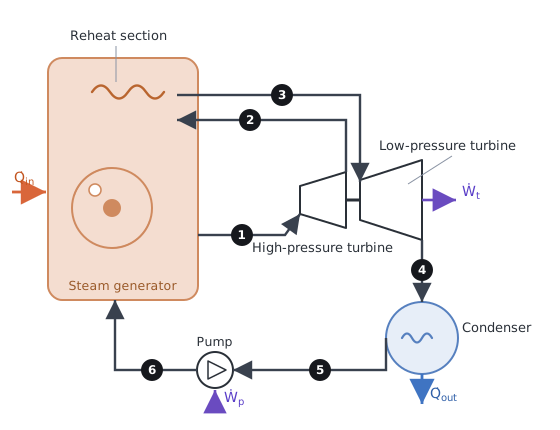
Reheat expands steam through a high-pressure turbine stage, returns it to the steam generator to be reheated, then expands it through a low-pressure stage. It keeps quality high while exploiting high boiler pressure. Efficiency accounts for work from both stages and heat from both heating passes:
Beyond superheat and reheat, plants raise efficiency further with supercritical operation, regenerative feedwater heating, and cogeneration — all developed in Advanced Rankine Cycles.在過熱與再熱之外,電廠還以超臨界運轉、再生給水加熱與汽電共生進一步提升效率——這些將於 進階朗肯循環 一章展開。
Principal irreversibilities主要不可逆性
The largest irreversibility in a fossil plant is external: combustion and heat transfer across the huge temperature gap between the flame and the evaporator tubes — the fire side of the boiler (subsystem A). Within the working-fluid loop, the dominant internal irreversibility is expansion through the turbine, captured by the isentropic turbine efficiency:
The pump has an analogous efficiency $\eta_p = (h_{4s}-h_3)/(h_4-h_3)$. Evaporator and condenser friction (pressure drop) are neglected at this level.
Ideal Rankine cycle理想朗肯循環
Example範例 Efficiency from the four states由四個狀態計算效率 ›
Given: turbine inlet $h_1=2758$, isentropic exit $h_2=1795$, condensate $h_3=192$, pump exit $h_4=200$ kJ/kg.
Find: thermal efficiency and back-work ratio.
Solution. $w_t=h_1-h_2=963$, $w_p=h_4-h_3=8$, $q_{in}=h_1-h_4=2558$ kJ/kg. $$\eta=\frac{w_t-w_p}{q_{in}}=\frac{955}{2558}=0.373\ (37.3\%),\quad \text{bwr}=\frac{8}{963}=0.8\%.$$ The tiny back-work ratio is the hallmark of vapor cycles.
Practice problems練習題
Work each one yourself first, then reveal the solution step by step.先自行作答,再逐步揭示解答。